I’d like to go to the cinema spontaneously – without worrying about subtitles
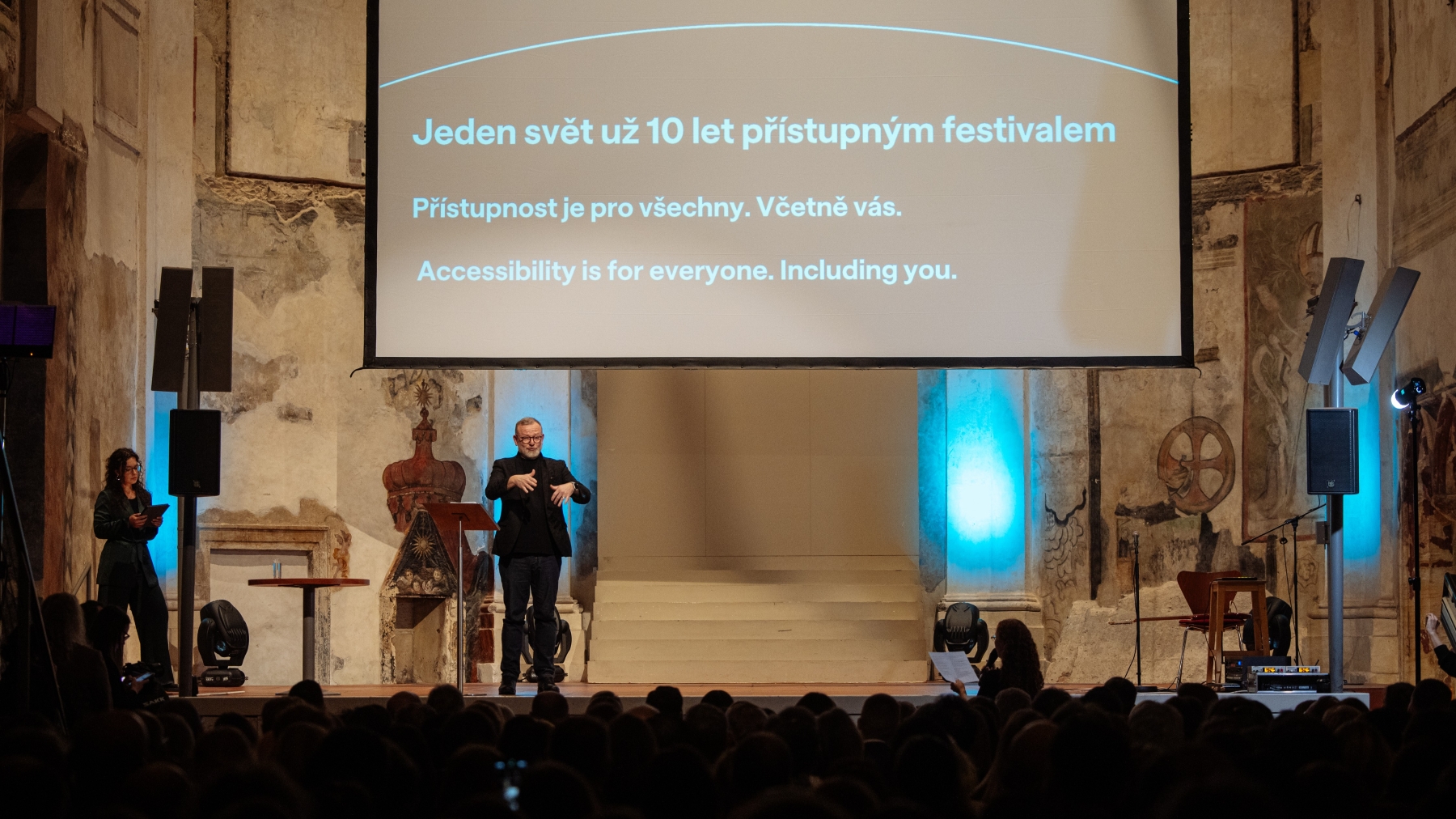
Just walking in and choosing a film based on your mood. For most people, this is completely normal – but for deaf people in the Czech Republic, it is rather an exception. So-called descriptive subtitles for foreign-language films, which help deaf viewers understand, for example, who is speaking when it is not clear from the image, are still not common. And when it comes to Czech films, subtitles in Czech are almost unheard of. What is it like to go to the cinema if you cannot hear? And what does a festival have to do to be truly accessible? These are the topics discussed by Petr Vysuček, director of the organisation Deaf Friendly. The One World festival has been working for ten years to make films and accompanying programmes accessible to everyone.
What options do deaf viewers have in the Czech Republic if they want to go to the cinema? Can they, for example, see Czech films?
To be honest, not many. Recently, my husband, my son and I – all of us are deaf – wanted to go and see Avatar 3. In Liberec, where we live, it was only available dubbed, so there were no Czech subtitles. In the end, we found out that it was being shown with subtitles in one cinema in Prague, so we travelled there.
Of course, we enjoyed the film, but it is exhausting to constantly deal with whether subtitles are available or not. You always have to adapt and limit yourself.
What is great about the One World festival is that all films have subtitles, and where needed, there are even descriptive subtitles. Suddenly, I do not have to figure anything out in advance and can simply choose a film based on what I feel like watching. That is exactly how I would like to go to the cinema in everyday life – to choose spontaneously, not based on subtitles, but on what interests me.
Regular subtitles are usually sufficient
Are standard subtitles enough for you, or do you need descriptive subtitles?
For me personally, standard subtitles are usually enough. I can understand a lot from the context and the visuals, so I do not always need to know exactly who is speaking.
However, it depends on the type of film. Sometimes someone speaks off-screen, and then it can be confusing. That is where descriptive subtitles make sense. But they do not necessarily have to be used everywhere automatically. The key is to look at the film from our perspective – would I miss something essential if it is not described in the subtitles?
What are descriptive subtitles?
Subtitles intended for viewers who are deaf or hard of hearing.
They capture not only spoken dialogue but also important sounds and audio information — such as who is speaking, music, background noises, or off-screen events.
Thanks to them, it is possible to understand the situation even without sound.
Descriptive subtitles are referred to as SDH (Subtitles for the Deaf and Hard of Hearing).
Are there cinemas in the Czech Republic that screen Czech films with Czech subtitles?
I think there are practically none. There is a general assumption that if a film is in Czech, it is automatically accessible to Czech audiences. But that is not true for deaf viewers.
It should already be common knowledge that subtitles are necessary for deaf people, so I do not really understand why this is still not standard practice. Perhaps it is due to a lack of awareness among distributors, or maybe it is about costs.
Accessibility is not just one service
The Deaf Friendly organisation has been working with the One World festival for almost ten years. How has this cooperation evolved?
It is a long-term learning process. Together, we try new things, observe how they work, and if something is not ideal, we look for another solution.
I think we learn a lot from each other, and thanks to that, the accessibility of the festival has been gradually improving.
What should a festival or cultural event provide to be truly accessible for deaf people?
It is important to think about accessibility in a comprehensive way. It is not enough to add subtitles to one film or provide interpreting for a single discussion. The whole visitor experience needs to be considered.
For example, where deaf viewers will sit so they can clearly see the interpreter. That is why seats in the auditorium are marked with hand pictograms. At opening ceremonies, where the guests are known in advance, deaf attendees receive an email with information about where to sit for the best view of the interpreting.
There are also video invitations in sign language on social media. These are always created by deaf people themselves, because sign language is an endangered language and it is important that it is represented by its own users.
It is also important that the festival team has taken courses in Czech Sign Language, which helps them better understand the needs of deaf audiences.
Accessibility is broader, however. It is not only about deaf people who use sign language, but also about those who prefer real-time transcription instead of interpreting, because they do not use sign language and prefer written text. It also includes the needs of blind people, wheelchair users, and accessible websites.
Accessibility is a long-term strategy, not a one-off measure.
One World for Deaf Audiences
- All films have Czech subtitles
- Selected films include Czech descriptive subtitles
- Selected discussions offer interpreting between Czech and Czech Sign Language, as well as real-time transcription in Czech
- Accessible screenings and discussions are marked in the programme with special pictograms:

- Reserved seating is available for deaf viewers, with a clear view of the interpreter
- Up-to-date information about the festival is available on the “Jeden svět pro neslyšící” Facebook page — including content in Czech Sign Language

A special discussion after a film about a legend of the deaf community
This year, the programme includes a film about the deaf actress Marlee Matlin: Not Alone Anymore. Have you had the chance to see it?
Not yet, but I am really looking forward to it. Marlee Matlin is a very well-known figure in the deaf community. The film Children of a Lesser God, for which she won an Oscar, is still very important to us today. We will definitely come to see the new documentary on Wednesday, 18 March, with the whole family.
Will the discussion after the screening be interesting for hearing audiences as well?
Definitely. The film is about a deaf actress, so it makes sense for the discussion to be led by a deaf moderator. My colleague Radka Nováková also knows American Sign Language. If the filmmakers join live, they can communicate directly in ASL.
I think this could be a powerful experience for many people, as well as educational.
People often see sign language as something like pantomime or Czech translated into gestures. But here, they will see that it is a fully-fledged language, and that its users can be linguists, moderators, or professionals capable of leading high-level discussions.
Film tip: Deaf
A documentary exploring the relationship between a hearing man and his deaf wife as they await the birth of their baby. The screening will be followed by a discussion with Anna Pangrácová, a deaf daughter of hearing parents, and Martina Kučová, a hearing daughter of deaf parents.
Tuesday 17 March, 17:15, Evald Cinema
Photo: Lukáš Bíba